In the past few months, I’ve watched three shows/movies that end, suddenly and unexpectedly, with a massive fire. What’s up with that? I have some thoughts.
Proceed with caution, spoilers ahead.
The first show is We Were Liars, which came out last summer and is based on a book of the same name that floated around the bookstores when I was in middle school. I definitely owned it, but never read it, so I had no idea what was coming.
Navigating her dysfunctional family, Cadence Sinclair spends a summer on Beechwood Island, her wealthy family’s estate with her cousins and family friend Gat. The story jumps between the present and previous summer as Cadence tries to figure out why she has amnesia and headaches, and why no one will tell her the truth of what happened to her.

What starts out as a show I affectionately referred to as a more mysterious version of The Summer I Turned Pretty slowly unfolds into an intense drama riddled with themes of privilege, trauma, and racism.
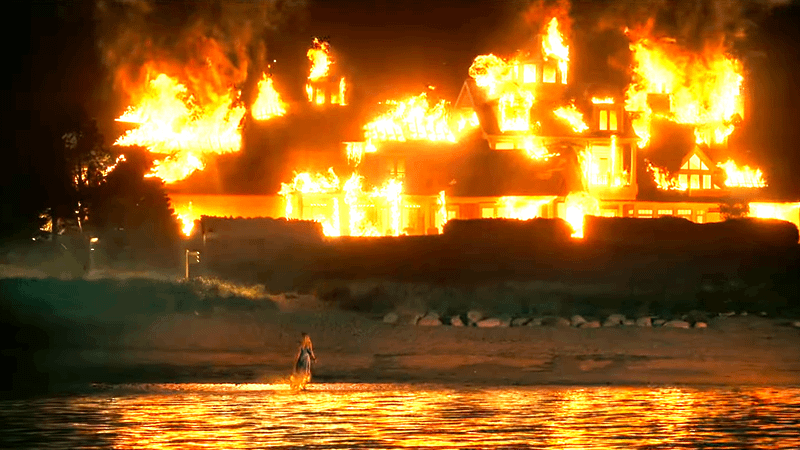
The story culminates in a massive fire, sparked by the teenage protagonists who reach a breaking point with the family’s rigid hierarchies, pernicious traditions, and web of secrets. While the adults are away, they develop a plan to pour gasoline over the entire estate to burn it to the ground, and with it, their toxic family history and wealth.
The second show is called Vladimir, which follows an unnamed middle-aged professor navigating her husband’s sexual misconduct at the university and an all-consuming obsession with a new younger colleague named Vladimir.

The professor eventually convinces Vladimir to join her at her cabin by the lake. In her lustful haze, she drugs him, uses his phone to accuse his wife of cheating, and lies to him. The two finally sleep together, and she suddenly figures out an ending for her novel that she was struggling to write throughout the show.
The professor’s husband arrives at the cabin and a fire breaks out. The narrator chooses to save her notebooks instead of helping the two men escape, and they are trapped inside while she escapes and watches the building burn.
The third, which I watched just this week, is a new Netflix movie called Roommates that packs every way your first year of college could go wrong into 107 minutes. While there’s a few good jokes, I spent more time cringing from second-hand embarrassment than enjoying the genre of “so bad it’s good” college campus movies I usually love.

Celeste, the manipulative daughter of the Staples CEO pretending to be poor, torments Devon, a girl from New Jersey looking for a fresh start in college. When Devon finally breaks with frustration from Celeste’s lies and poor roommate behavior, the two get in a screaming match and Devon uses her RA’s blowtorch to light the room on fire. They burn the entire dorm down, and Celeste drops out to work at Staples while Devon spends two months in jail.
My experience watching each of these was similar. We Were Liars and Vladimir had plots that unfolded at an almost-too-slow of a pace, making me half-heartedly question how they were going to resolve the story while I scrolled on my phone. Roommates felt predictable, at least at first—it depicted common lived experiences everyone has encountered one way or another, and if I interrogated my college bad dreams, I could probably figure out the next scene. With all three, I had to convince myself to watch till the end.
It was in the home stretch when my attention was jerked from my phone, my eyebrows raised in shock as houses and dorms were burning to the ground. The plots had yet to capture my attention and I wasn’t particularly invested in the complexities of the characters’ fates. However, the fires made me want to rewind to see what I had missed.
What does it mean that each lethargic story ended in sudden flames?
I have a few ideas.
First, it could simply be lazy screenwriting. The best way to tie loose ends together is to just burn them all away and give the characters a more pressing issue to deal with—the threat of imminent death.
These combustive endings could also show us the transformative consequences of what happens when a woman’s emotions break free from containment. In an uninhibited expression of feelings after a stretch of dull storytelling, each female protagonist is able to tear down the current forces shaping their lives in unfavorable ways.
Cadence and her friends’ frustration leads them to destroying the root of their troubles—their family’s wealth. The professor, overcome with lust, writer’s block, and a scandalous husband, is freed of all those problems as she escapes the burning cabin. And, Devon’s pent up rage from not only Celeste’s manipulation but a lifetime of bad friends culminates in a fiery explosion.
The fires force each woman to make a choice between her old life and her new self.
Cadence must choose between saving the family golden retrievers who are locked in a room and saving herself from the flames. With deep sadness, she chooses her own life over the spiritful dogs that her patriarchal grandfather had a particular attachment to, breaking free from the pressures of upholding the family hierarchy.
The professor must choose between rescuing her manuscript or Vladimir and her husband. She chooses her writing, an artistic culmination of her bottled up desire, over the two men. As she runs out of the burning house, her voiceover says: ““Just like in a Gothic novel, that obsession, that thrill of desire, goes up in flames…I have to make a choice, a whole new life.”
Devon must choose between her childhood sloth stuffed animal and Celeste, who was trying to destroy it. Devon ultimately pushes Celeste into the fire, choosing her truest self over what she had always yearned for: a friend, albeit toxic and superficial.
Each protagonist breaks out of their unhappy monotony—slow and boring stories—and chooses their own futures by literally letting their old lives burn to the ground. As Celeste and Devon argue next to the growing flames, the RA steps in and says, “Lots of big feelings, goddammit. I gotta put this shit out.” She puts a blanket on the flames and it immediately grows bigger.
Each of these stories show us what happens when you put a blanket on a lot of big feelings—desire for freedom, artistic expression, love, lust, friendship. Even when the story seems slow, the emotions compound, leading to fires that burn everything down, for better or for worse. Each woman’s life is transformed—Cadence grapples with her brain injury and trauma after the fire; the professor has an artistic epiphany and publishes a book; and Devon goes to jail but finally makes a good friend while she’s there.
We Were Liars and Vladimir have unreliable narrators—we learn that in the present day summers, Cadence’s friends had died in the fire and she was imagining them. The protagonist in Vladimir, after she has escaped the house with her manuscripts, speaks to the camera and says, “Don’t worry, I called 911. Everybody gets out. You don’t believe me?” In one case, characters we thought survived the fire are revealed to be dead, and in the other, men we assumed had perished could actually be alive.
Along with ash and soot, the fires leave ambiguity in their place. In both shows, we don’t fully know who survives and who perishes. The only confirmed outcome is that the female protagonists emerge transformed, and ultimately, have created a better world for themselves.
Perhaps there’s an even broader point to be extracted from these eventful endings. These stories are priming their young, female viewers to accept complete destruction as a viable solution for their common interpersonal problems—and eventually, broader political ones. They’re demonstrating that, facing a system or situation that does not work nor present any procedural escape, we can burn the entire thing to the ground.

 catfitz
Leave a reply to clearly0d58d0a369 Cancel reply