Author: Catherine Fitzgerald

  • Power Playing: Vocabulary and AI

    Storytellers Rule the World

    A UCL professor told BBC that “in political speeches, metaphors are chosen ‘purposefully and really consciously to try to make people perceive a situation in a certain kind of way.” 

    Think about the COVID-19 pandemic, when wartime metaphors like doctors “fighting” on the “frontlines” helped paint medical professionals as “brave” and encouraged everyone to honor their “sacrifice” through nightly applause from balconies. 

    Metaphors and other carefully chosen words are also used to shape the narrative of AI. Because AI is inconsistently adopted, tech leaders must first rely on telling and not showing to convince us to integrate it into our everyday lives. They’re marketing a product, and they need to sell it to us in order to pay off the immense financial investments they’ve made in AI’s success.

    They push sensationalist and future-oriented vocabulary to make AI seem desirable, but that language often fails to align with lived experience, producing anxiety, skepticism, and resistance. This is an exploration of how they use language to engineer AI’s narrative and how that directs its future.

    The disconnect you’re feeling between how AI is marketed towards you and how you’re experiencing it is not inconsequential, and it’s important to be aware of how language shapes your perception of it as tech leaders readjust their approaches to further convince you to accept AI.

    “Big Tech also largely shapes how we think about and perceive AI, as it owns most of the popular AI tools and dominates narratives of AI harms and benefits, both now and in the future, all heavily influenced by profit-making interests and worrisome ideologies.” – Nadia Piet

    “The Weapons and Wars Behind the Words

    Before we discuss AI, I want to tell you about Carol Cohn’s 1987 essay titled “Sex and Death in the Rational World of Defense Intellectuals,” because it is an excellent example of how language and metaphors can be used to exert and gatekeep power.

    Cohn is an expert on gender in global politics, particularly conflict and security issues. She immersed herself in the world of (male) defense intellectuals, learning their unique language and lingo to deduce how it shapes the nature of their nuclear strategic thinking. 

    She found their language to be key in structuring how they think and act, and that this language was full of abstractions and euphemisms that distanced them from the realities of nuclear warfare. It was riddled with overtly sexual, domestic, and religious metaphors that functioned to connect masculine sexuality with the arms race, to minimize the seriousness of war, and to claim status and power. 

    The language’s virginity metaphors, vivid imagery of white plumes, and phallic shapes of nuclear explosions neutralized warfare’s aggressive competition for manhood into mere “boyish mischief.” Domestic imagery like “RVs,” “BAMBI,” “Christmas tree farms” and “cookie cutter” worked to both “humanize insentient weapons” while also making it “all right to ignore sentient human bodies, human lives.” Even religious metaphors like “the nuclear priesthood” functioned to “claim the virtues and supernatural power of the priesthood” and tacitly assert that these defense strategists are the “creators of dogma” and have become godly. 

    Through these functions of language, nuclear weaponry and deadly technology become something manageable and separate, enabling these seemingly normal individuals to continue doing this type of destructive work while muting ethical repercussions. 

    Cohn notes that speaking this language is enjoyable: “The words are fun to say; they are racy, sexy, snappy…You can reel off dozens of them in seconds, forgetting about how one might just interfere with the next, not to mention with the lives beneath them.” The process of learning the lingo, she adds, took most of her energy and attention, keeping her away from considering the “weapons and wars behind the words.”  

    By design, the language offers a feeling of being one of the few people “in the know.” The summer program that granted her access into these spaces was funded and lavish, adding to the feeling of power and exclusivity. She even found that when she refused to speak in these abstractions, the men treated her as if she was ignorant and simpleminded, emphasizing the necessity to view defense strategy through the metaphors.

    I was most interested by her realization that learning this language offered a profound sense of control. She writes:

    “You can get so good at manipulating the words that it almost feels as though the whole thing is under control. Learning the language gives a sense of what I would call cognitive mastery; the feeling of mastery of technology that is finally not controllable but is instead powerful beyond human comprehension, powerful in a way that stretches and even thrills the imagination. The more conversations I participated in using this language, the less frightened I was of nuclear war.”

    Story Architects

    TIME Magazine declared “The Architects of AI” as its 2025 Person of the Year and wrote: “AI emerged as arguably the most consequential tool in great-power competition since the advent of nuclear weapons.” Both nuclear defense strategy and AI represent moments of collision between powerful people making unilateral, life-altering decisions, and those who must follow their lead or be left behind. 

    In both cases, our perception of the technology is not neutral; it’s deeply intertwined with experiences of power, control, and fear. And as we see with Cohn, language plays a huge role in mediating and shaping that experience. 

    Like nuclear strategy, AI can be rendered manageable and even desirable through language. Tech leaders are both building AI and handing us the words to describe it. As we, the average technology users, become immersed in the vocabulary and promises of AI, we too may become thrilled and less frightened about this potentially humanity-changing technology. 

    That’s the tech leaders’ hope, at least: to create a vocabulary so snappy and sexy that we can’t help but fall in love with AI (even if the actual product is overpromised and has its own potential dangers). They have to rely on a language that frames AI as inevitable and imperative—the stakes of unfathomable wealth and legacy are too big and just within reach.

    The new AI language has successfully permeated our personal and professional lives. The fact that several dictionaries made AI terms like “vibe coding” their 2025 words of the year only enforces their longevity. They’re now part of the official cultural lexicon that everyone is expected to know.

    Cohn argues that learning a language is not additive; you don’t just learn new vocabulary and information. She says it’s transformative, and that “when you choose to learn it you enter a new mode of thinking.” 

    TIME’s article, centered around a profile of NVIDIA CEO Jensen Huang, made the narrative of inevitability and necessity explicit, weaving it into their account of the past, present, and future of AI: This is the story of how AI changed our world in 2025, in new and exciting and sometimes frightening ways. It is the story of how Huang and other tech titans grabbed the wheel of history, developing technology and making decisions that are reshaping the information landscape, the climate, and our livelihoods…It describes a frantic blitz toward an unknown destination, and the struggle to make sense of it.”

    A group of powerful men grabbing the wheel of history and charting unknown territory without consideration for others is a familiar story in American history. Leaders seize what they want in the name of expansion, innovation, and exploration. 

    The TIME authors’ language evokes powerful metaphors of all-American frontierism—where thrill, hope, and destiny (supposedly) shape a new future for all—while also reminding the careful reader of the extreme consequences that hindsight has revealed from those same historical moments.

    The article pens an official account of the past year in AI, and feels like an entry into the history books of what happened in 2025. The story is balanced and addresses both advancements and challenges, from data centers to mental health crises.

    However, its language still reinforces that AI is here to stay. It frames this small group of leaders as authoritative visionaries, guiding the world through this inevitably and out of control moment. The piece ends: “Thanks to Huang, Son, Altman, and other AI titans, humanity is now flying down the highway, all gas no brakes, toward a highly automated and highly uncertain future.” 
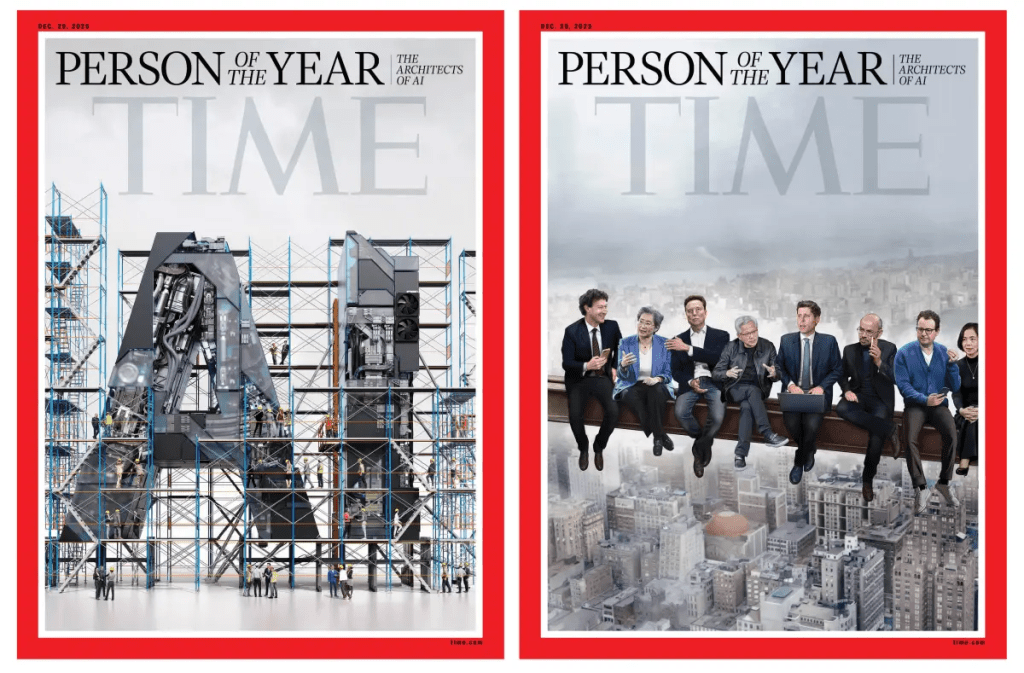
    Even though the article isn’t written by the tech leaders themselves, it cements their dominant narrative of AI into the story of 2025: that it’s barrelling forward, with no regard for concerns nor a concrete answer on what this new future will look like.

    That narrative is not new; it was intentionally built and sustained by the tech companies over the past few years in order to convince us that their new and life-altering product is essential and inevitable. As Cohn urges feminists concerned about nuclear war to “give careful attention to the language we choose to use—whom it allows us to communicate with and what it allows us to think as well as say,” the same question applies here—what do the words we are given allow us to think?

    The Vocabulary

    Frontier hype words like breakthrough, revolutionize, and milestone emphasize speed and inevitability, driving momentum and contributing to the notion of an “AI race.” They feel auspicious and optimistic, but can also come across as sensationalist and empty when used unsparingly. Words like those can even sound so intangible that they mirror the flattened language produced by large language models, which often generate words whose meaning you cannot “see” when reading them.

    Just skim through this Google blog post. Yes, the technological advancements are pretty cool, but the words felt like they were begging me to believe them. Transformative, unprecedented, empower, advance, enable, deliver, power, capable, lead.

    In order to become an essential component in all aspects of human life, AI must have this sense  of urgency, snowballing towards a (singular) future without giving the individual enough time to catch up. These are all active words that remind us that other people (and the AI models themselves) are working towards a better future and that we should be too.

    AI companies must convince us that AI can and will solve all of our inconveniences. This makes opting out seem like just a personal failure to use the available tools. AI is the new norm, and it’s an individual’s fault if they don’t keep up (yet another familiar narrative).

    However, these breakthrough words must be paired with more concrete words to convince us that this future is already here, and that it’s not just a distant fix for all our problems. These words work to reduce fear of the unknown and make adoption feel achievable. 

    Practical words like implement, roll out, integrate, automate, simplify, demo, guide, and toolkit, combined with temporal terms like last month or early next year all position AI as digestible and manageable, even if the technology isn’t fully realized. 

    There’s also adjectives that bolster AI’s intelligence and respectability. AI is rational, decision-making, independent, logical, generative, rational, complex, agentic, purposeful. These words draw disproportionately on traits historically coded as masculine and authoritative. 

    Words like agent make AI appear proactive; words like assistant or copilot make it appear helpful. Words like superintelligence and neural network connect the technology to humans, making it more understandable and even respectable. Human names like Alexa anthropomorphize it. 

    And it’s not just specific words; broader storytelling techniques work to subconsciously associate AI with positive attributes. The AI leaders use metaphors that draw on our human need for survival. AI pioneer Andrew Ng and Google CEO Sundar Pichai have compared AI to electricity and fire, insisting that it will be equally as impactful on humanity. Every industry, Andrew claimed, will be transformed by, and ultimately rely on, AI, just like they do electricity. 

    Using language to sell something is a time-old marketing tool. But for AI, these linguistic manipulations feel like just that—the powerful and confident words don’t align with our lived experiences. 

    A Reminder of Control

    There’s a growing dissonance between how AI is described by the tech companies, how it is experienced, and how it is culturally absorbed. The more aggressively tech leaders insist on AI as essential and good, the more visible resistance becomes. 

    Even as AI is framed as empowering and hopeful, we still experience it as abstract, imposed, and politically charged. The positive impacts of these technologies have yet to regularly impact our everyday lives, creating a disconnect between how the companies discuss AI and how we experience it. 

    Beyond the more immediate consequences like losing jobs and diminishing critical thinking, there’s an additional layer of discomfort and anxiety. AI has become a place where hidden power dynamics become explicit, creating a fighting ground for persisting political and class tensions. 

    AI makes the power of tech leaders, and their ties to politics, impossible to ignore. You can’t talk about AI without talking about regulation, ethics, and control—it’s telling that the TIME article begins and ends with quotes from Donald Trump. Nearly half of Americans think that Trump is carrying out a pro-Big Tech agenda when making tech policies, and does not have the people’s best interests in mind. 

    AI is also a reminder of the amount of power we have over our own lives. If it can transform our jobs, creativity, and livelihoods all in less than five years, how much control do we actually have? Even if we finally accept and use AI to reclaim agency, it was AI that made us feel out of control in the first place. As we gain false control, the tech leaders cement their actual control.
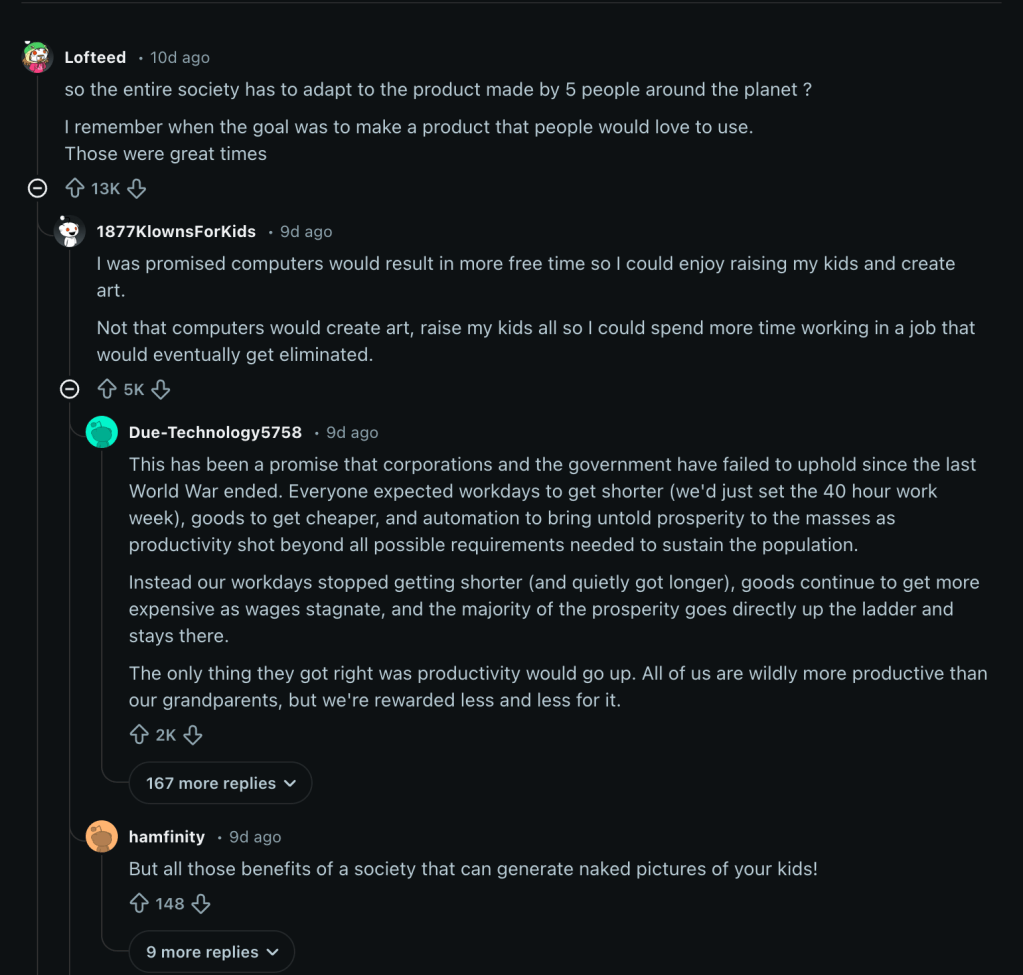
    Every other week, it seems, an AI leader issues a statement about AI’s transformative properties and tangible results for the near future, whether that’s expediting scientific discovery or writing code (in a good way, not a bad way, they say!). 

    Shortly after those announcements, an AI “godfather” or even some CEOs announce various fears for AI and humanity’s future. Some say they want to slow down AI until we can agree on a more ethical and safe direction. The narrative flips back and forth from extremes of doomerism to hype, in a push and pull between company competition and ethical considerations. They scramble and even compete with each other to tell the right story to win our attention.

    We’re at the beginning of a reckoning amongst tech leaders that their narrative and language aren’t working, and that AI needs a rebrand. 

    They’re abandoning inconsistent and overhyped definitions of AGI; they’re realizing they need to show people how AI can actually improve their lives before they lose them; they’re insisting that people’s skepticism has a detrimental effect on their business. They’re making new metaphors. Even some of the websites got a softer rebrand. 

    People are also creating their own narratives to fight back. “Slop” was a term not developed by the tech executives. In fact, they don’t really like it

    AI companies earned a captive audience with such rich storytelling, and now they’re losing it. If tech companies want to win them back, they need to think about the broader AI narrative that goes beyond just impressive technological innovation—they need to think about the lived experience, how people resonate with stories, and let AI be a tool that democratizes the imagination and creation of a better future, not shoves one version of it down people’s throats. 

    With the language they’re using, it may seem life-or-death. The race to AI has even been compared to the race to develop nuclear weapons—recently, Anthropic CEO Dario Amodei likened Trump’s decision to sell AI chips to China to “selling nuclear weapons to North Korea.”

    But don’t let their urgent and extremist language fool you. They don’t know where the story is going, and they can’t turn the page until we are all on board. AI could have a lot of societal benefits, from drug discovery to weather prediction. But there needs to be some more collaboration and imagination in creating this technology; it can’t solely come from an isolated billionaire class. 

    Cohn ends her essay by saying: “Our reconstructive task is a task of creating compelling alternative visions of possible futures, a task of recognizing and developing alternative conceptions of rationality, a task of creating rich and imaginative alternative voices—diverse voices whose conversations with each other will invent those futures.”

    Let’s break out of the language created by those tech leaders who balance on the scaffolding. We have so many words, so many metaphors, so many stories that we don’t have to let our voices be constrained or homogenized into the hyped voices of these tech leaders or the single bland voice of an AI chatbot. 

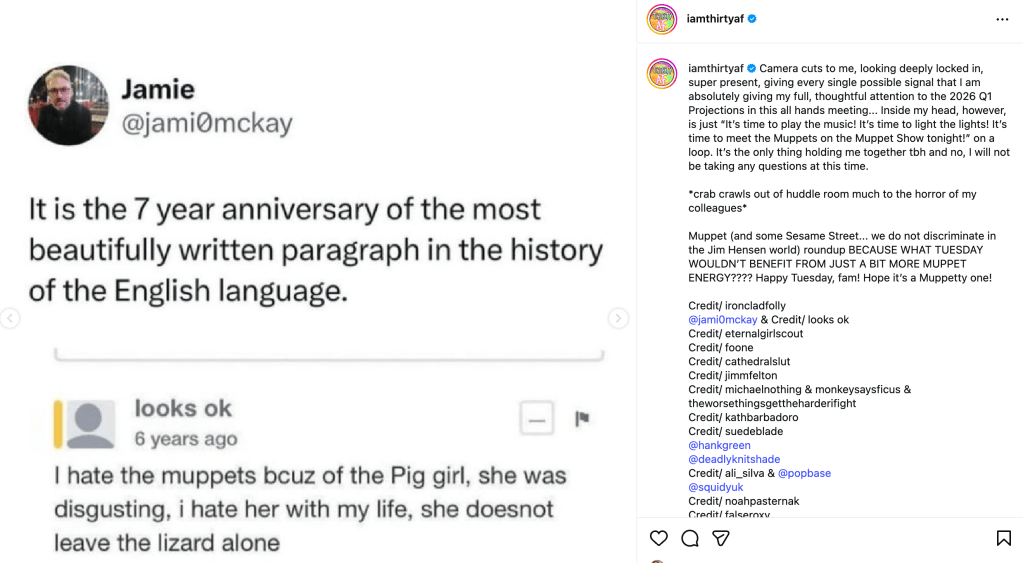
  • 2026: The Year of Miss Piggy

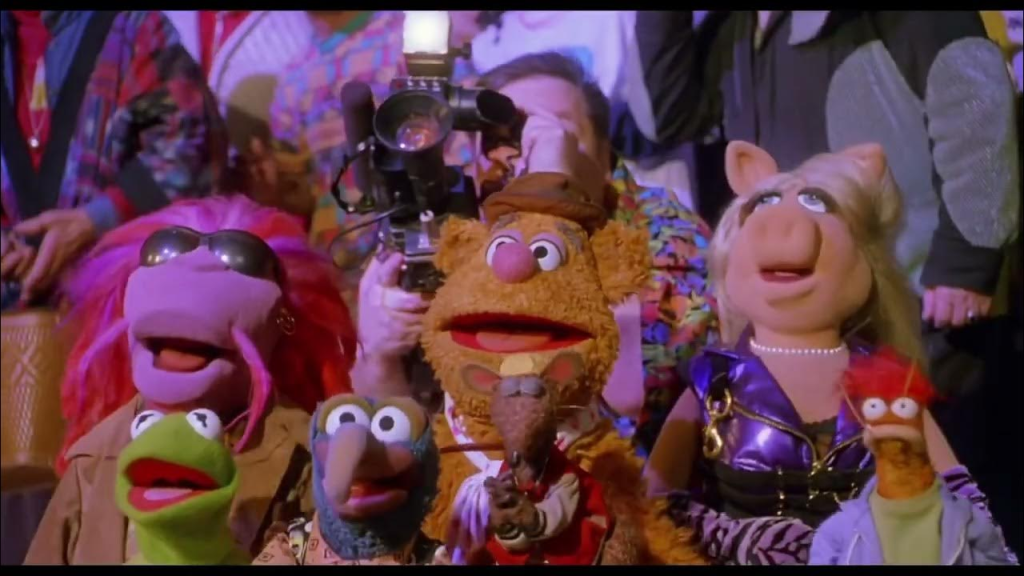
    Miss Piggy has always demanded the spotlight, and she’s about to get it. Disney is priming the world for another Muppets return and Miss Piggy will be at its center.

    My essay examines the Muppets’ tumultuous cultural presence and Miss Piggy’s past and future feminism to understand where her return fits into culture now.

    The Muppets

    The Muppets have had a rocky history. Since Disney’s acquisition in 2004, the company has struggled to balance the franchise’s broad audience demographics. There have been several attempted “revivals,” moments when Disney tried to force the characters into every crevice of popular culture, but none seemed to last.

    In articles for the NYT, one in 2008 and one in 2015, NYT Hollywood reporter Brooks Barnes outlines two of these attempts, noting that “The Muppets are hardly moribund, but they do represent one of the most striking examples of franchise fumbling in Hollywood history.” 

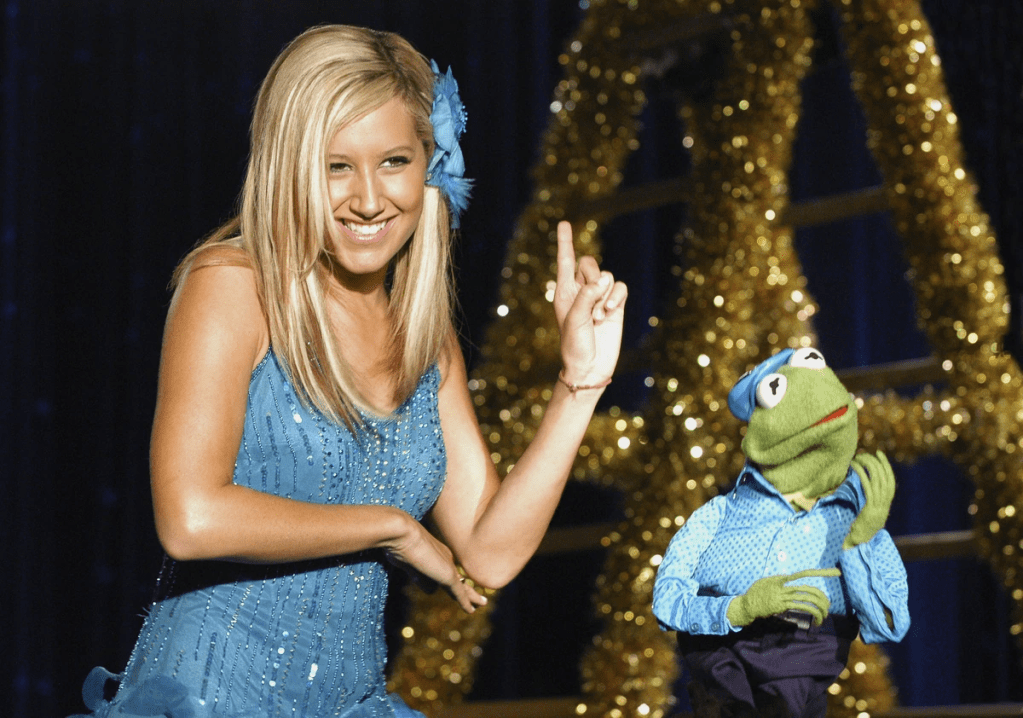
    The Muppets first underwent a “fuzzy renaissance” in the late 2000s, he writes, and received the “Hannah Montana treatment” to expand the franchise. They were everywhere, from Muppet-version sketches of popular shows to various merchandise collabs.

    After a strong-ish run in the 2000s and early 2010s that culminated in one of my favorite movie musicals of all time, The Muppets (2011), and a collective star on the Hollywood Walk of Fame in 2012, the Muppets drifted yet again into only mild commercial success.


    Side note: I think about this person who got the “Man or Muppet” lyrics tattooed across their entire body every single day.


    In 2015, there was another attempt to reinvigorate the franchise and introduce it to a younger generation. Barnes notes that “‘The Muppets’ will intentionally serve up nostalgia, at least to a degree,” but that “playing to misty-eyed older fans while feeling contemporary enough to attract younger new ones is a difficult magic trick to pull off”—one that they failed the last time.  

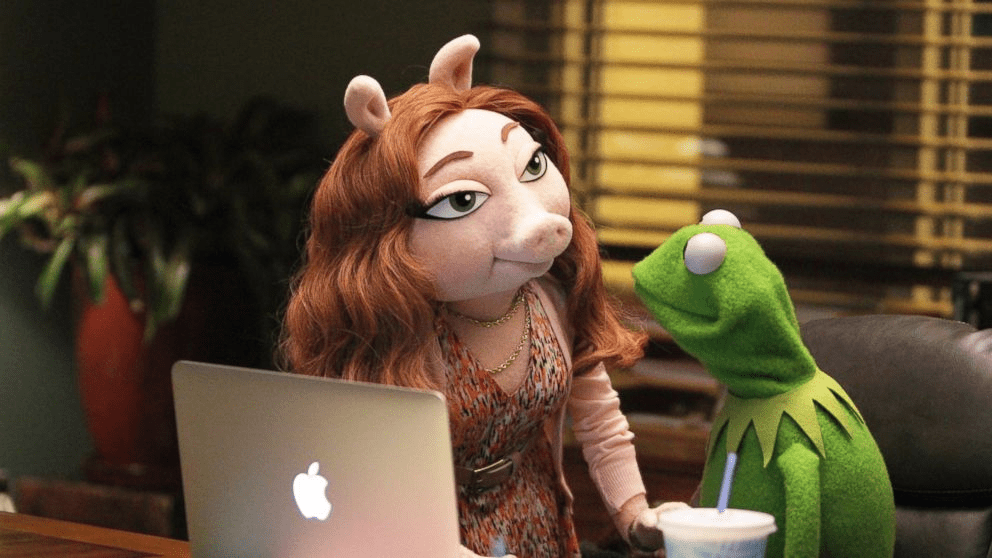
    Disney’s new efforts consisted of two Muppet ABC comedies. First came “The Muppets,” a mockumentary-style show similar to “The Office” that followed the production of the second show, “Up Late With Miss Piggy.” We got more insights into the character’s personal lives and a storyline where Kermit dated an ABC executive named Denise…who was also a pig. Both shows were canceled after one season. 

    “The Muppets” (2015) veered so off brand that The Guardian wrote, “This version of Kermit is absolutely unrecognisable from anything that’s ever come before. This Kermit badmouths fellow celebrities, openly discusses his sex life and, at one point, describes his life as “a living hell”. That’s not who Kermit is.”

    Over the years, Disney’s brand strategy for The Muppets has been throwing spaghetti at the wall and seeing what sticks. Each attempt reflects a desire to align the franchise with contemporary culture, and understanding where they’ve failed helps us piece together their moves going into 2026. I’m sensing yet another Muppets revival, and we’ll have to wait and see if Disney applies a more strategic approach.

    The Muppets in 2026

    The Muppets have begun to creep back into the public consciousness; Disney’s testing yet again where they fit in contemporary culture through theater, social media, comics, fashion, and themed in-person experiences.

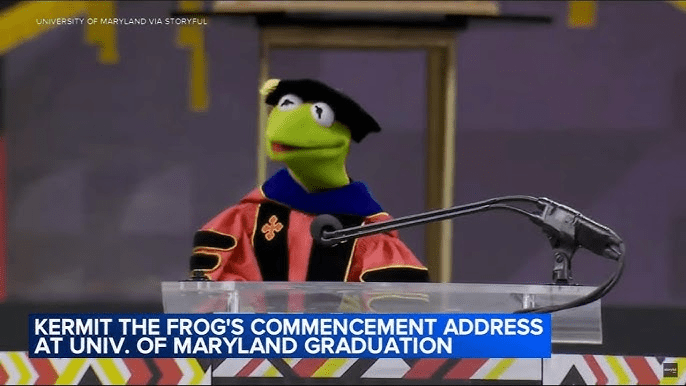
    The franchise’s 70th anniversary this past year brought a weekly character spotlight on social media, Muppet-variant Marvel comic covers, and even a heartwarming graduation speech by Kermit at the University of Maryland, where Jim Henson attended. They also announced a brief Broadway run with a comedian (which didn’t do as well as expected) and a tasteful Gap collaboration. 

    If that doesn’t convince you of their return, I’ve seen a statistically significant number of Muppets carousels on various meme accounts I follow, and they’re always ahead of the trends.

    This time around, in efforts to fuel nostalgia while also attracting new fans, Disney has closed MuppetVision 3D at the parks, removing a long-standing attraction and leaving fans with a Muppet-shaped hole in their hearts.

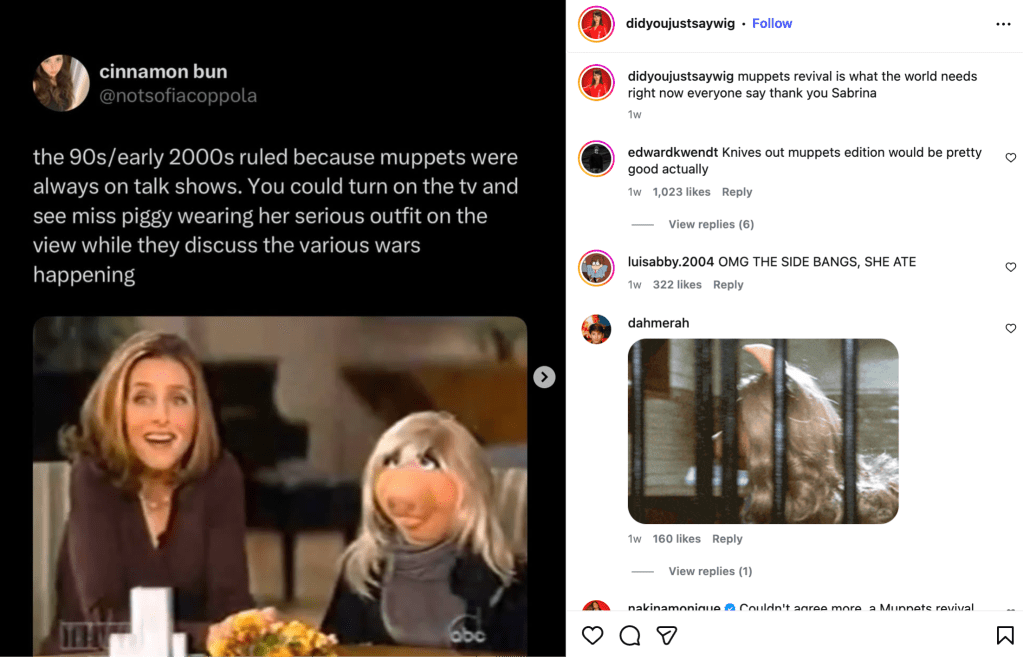
    Next year, The Muppets will celebrate the 50th anniversary of “The Muppet Show” with a revival special featuring Sabrina Carpenter, our current pop princess. They will also take over the Rock ‘n’ Roller Coaster at Disney’s Hollywood Studios as its new resident rock stars, replacing Aerosmith when the ride closes in early 2026 and reopens later in the year. 

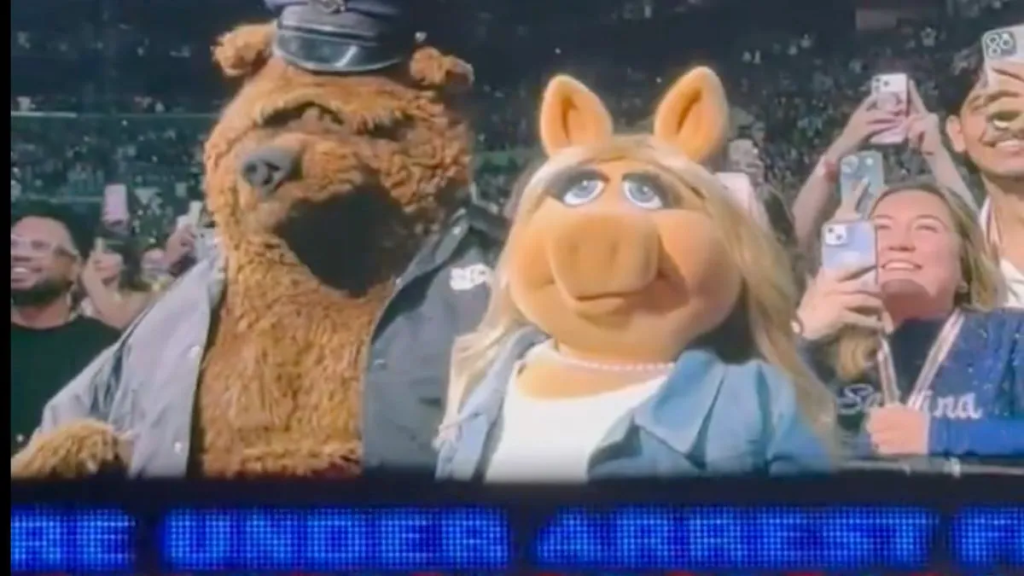
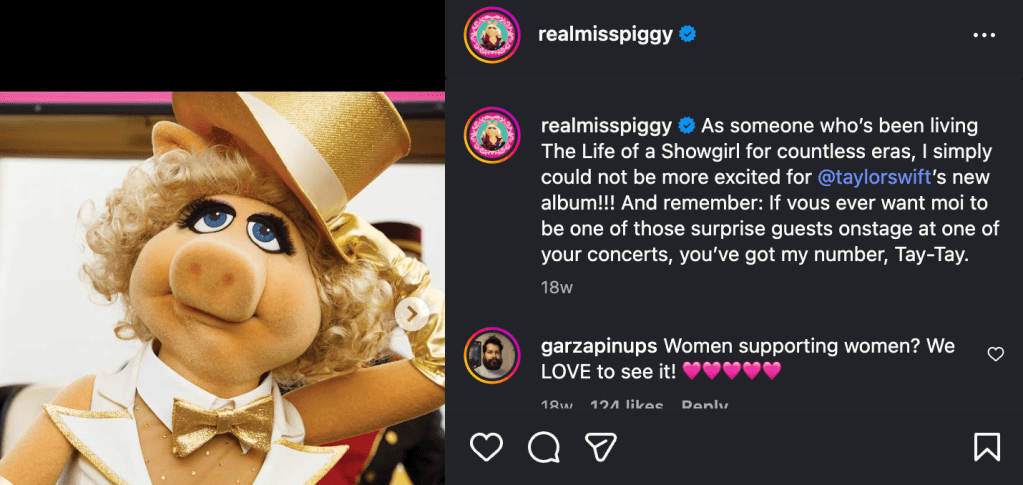
    Sabrina Carpenter is the perfect cultural bridge for the Muppets’ comeback, and especially for Miss Piggy. Their personalities align: both possess tongue-in-cheek sarcasm, strong aesthetics, glamor, and theatrics. Sabrina’s Short n’ Sweet tour, with its fake live-show framing and sketch-like interludes, mirrors the original “Muppet Show” and “Up Late with Miss Piggy.” Recently, Miss Piggy (and Bobo the Bear, dressed as a security guard) appeared as the celeb guest at Sabrina’s tour in a segment where she “arrests” someone before performing her song “Juno”—a clever promo for their upcoming collab.

    A Muppet Show special is a good idea for an audience eager for reboots and throwbacks. In an age defined by artificial intelligence and a widely discussed “loneliness crisis,” live, flawed and collaborative art, whether human or Muppet, is exactly what people want.

    There’s comfort in camaraderie and seeing the effort, love, and joy that went into a project. Disney is doing this successfully elsewhere, from the newly released Eras Tour docu-series that shows how Taylor Swift’s global phenomenon came together to the renewed success of ABC’s Dancing With the Stars this fall, which saw record voting participation and leaned into the vast repertoire of Disney-owned content.

    Miss Piggy

    While all of the Muppets have a special place in my heart, Miss Piggy has always been a favorite. She was even my Google account profile picture before I started applying to jobs and had to switch to something slightly more professional.

    She’s an obvious candidate for pulling the franchise back into the mainstream. Beyond her similarities to Sabrina Carpenter, she maintains ties across contemporary culture. From being a guest judge on Rupaul’s Drag Race in 2021 to potentially inspiring singer Chappell Roan, she’s ventured into queer spaces. She also moves in step with various cultural moments, including the girlhood and feminine rage trends of 2023, which positions her to slide into whatever broader trend that culture veers into next without it feeling forced. Even her visual aesthetics align with recent trends like maximalism or mob wife. 

    Miss Piggy’s Feminism

    One of my favorite parts about The Muppets is that they are fictional, non-human characters yet they also exist in the outside world. They are able to publish books, win awards, go on talk shows, and hang out with celebrities in real life. However, this also opens them up to the complicated politics of being a real life public figure. 

    I’ve read enough celebrity memoirs to sympathize with the challenges of fame and understand the nuances of sharing personal political beliefs, using your platform for good, and protecting your brand, personal life, and sanity. 

    But what happens when a public figure is fully fictional and their opinions are carefully crafted by a global multi-media corporation?

    I’m interested in this dynamic and how Disney will navigate it as it boosts its Muppets content. As Kermit said at a 2015 Television Critics Association press tour: “Like most Hollywood stars, we are wholly owned subsidiaries of some big company, and, you know, that gets strange.”


    I did some digging into Miss Piggy’s past and found an impressive and expansive resume: a New York Times bestseller, an Academy Award nominee, a guest at King Charles III’s coronation, and…a feminist. 

    In 2015, Miss Piggy was honored with a Sackler Center First Award from the Elizabeth A. Sackler Center for Feminist Art at the Brooklyn Museum, which celebrates women breaking gender barriers and remarkable achievement in their fields (Yes, that Sackler family…).

    Other recipients of this award include Anita Hill, Toni Morrison, and Angela Davis. What has Miss Piggy done that places her alongside these high-profile female changemakers?

    Miss Piggy answered that herself in a questionable TIME Magazine essay, in which she insists that she is a feminist because she does not fit the popular image of a feminist.

    Instead of marching in women’s rights parades, she writes, she marches down Fifth Avenue to go shopping. Instead of burning her bra, she saves money and doesn’t waste her high-quality intimates. 

    In other words, because Miss Piggy says she’s a feminist, she is one, no matter her actions. The future of feminism, she insists, is to be a lot more like “moi,” Miss Piggy’s way of referring to herself.

    However, if you read beyond the article’s title (Miss Piggy: Why I Am a Feminist Pig), you find a vacant essay that denies any real political commitment. Miss Piggy distances herself from the traditional “negative” perception of a feminist and creates her own definition that centers consumption and individual success; it is reduced to a mere personality trait and is undermined by humor.

    This all tracks for 2015, the height of the girlboss era and celebrity feminist bandwagoning, when being a feminist became crucial for personal branding. Neoliberal feminism in the early 2010s separated feminism’s public image from collective and intersectional struggle, instead emphasizing individual (mostly financial) success. Suddenly, after Beyonce danced in front of a “FEMINIST” sign at the 2014 VMAs, a wave of female celebrities walked back previous statements and vaguely declared themselves feminists. 

    Miss Piggy was no exception; her stumbling entry into feminism was unconvincing and stereotypical. Beyond the flimsy TIME essay, her persona on “Up Late With Miss Piggy,” as described by Willa Paskin in Slate, embodied many negative traits disproportionately used to criticize women, including “bossy, shrill, hysterical, irrational, [and] moody” (not frumpy though!).

    Willa notes that this iteration of Miss Piggy is not like other complex and flawed female protagonists who are often “not primarily, or even particularly, concerned with being likeable.” Instead, Miss Piggy is simply intolerable and unpleasant. 

    In trying to distance herself from feminism’s “negative” reputation, Miss Piggy ends up embodying it. Her feminism is all attitude and no action, and furthers an association between feminists and being unlikeable. 

    Unable to sustain a convincing feminist argument, Miss Piggy concludes her essay by playing the “Porcine American” card and claiming “species-ism” as to why she is excluded from the movement. She says that pigs have long been associated with the opposite of feminists—male chauvinists—and that’s the reason people are doubting her politics, not her lack of substance. Not burning her bra, she argues, was not a political statement but common sense.

    Miss Piggy will never face the consequences of her feminism. However, though she’s a fictional pig, she speaks to real issues, functioning as a mouthpiece to advance Disney’s political and PR goals without the risks and conflicts of interest of human spokespeople. 

    Given this, and the fact that she is literally voiced by a man, I don’t think we should listen to, praise, or amplify Miss Piggy’s “feminism.”

    Yet, I can see the Internet calling her an “icon” next spring, celebrating her outspoken nature and diva personality. She will have viral moments and possess the franchise’s ability to insert herself into any mainstream narrative, not unlike brands’ social media accounts that quickly tap into relevant cultural moments.

    As a corporate Muppet, Miss Piggy poses no real threat to the patriarchy, but that may be exactly what will allow her “feminist icon” branding to catch on. With conservative feminism becoming more mainstream, her appeal rests in her ability to satisfy the internet’s desire for feminist icons while ultimately reinforcing the very non-radical and corporate values that keep her unthreatening and profitable.


    Miss Piggy is not the feminist icon people need, but she may be the one that people want. As Disney gears up for another Muppets revival, her brand of feminism (snarky soundbites, assertiveness, and uninhibited aggression) will likely take center stage.

    Most people encounter feminism through popular culture, watching a clip on their feed instead of critically engaging with feminist publications or grassroots organizations. While this could be an entry point into the movement, it can also replace political engagement and provide an illusion that feminism is already resolved.

    Mainstream feminism will always be restricted by corporate financial and reputational concerns. Just like Miss Piggy’s TIME essay, it serves business interests over the collective, and is never radical or structure-changing.

    I’m not asking Disney to adopt a more nuanced and improved version of feminism, because I don’t think it will. When the company has attempted to rewrite antiquated narratives in its live-action remakes in the past, it has faced backlash from both ends of the political spectrum and lands in a safe and unsatisfying middle ground, pleasing almost no one.

    Given Miss Piggy’s impending rise, I am wondering if and how Disney will approach her persona differently, and if and how she will appear in feminist narratives.

    Barbie (2023) offers an example of feminism entering the mainstream through a corporate vehicle. While it was widely critiqued, it sparked a large conversation about modern feminism that I have to believe did some good. A new generation got a intro course on feminism, and timed alongside various “girlhood” trends, feminism (albeit simplified and white) briefly became center stage.

    Barbie used nostalgia to expose its own unresolved feminist missions instead of smoothing them over. The film initially celebrates how Barbie has shown girls they can be anything, but the dolls realize that representation in Barbieland does not translate into actual power in the real world as soon as Ken returns with the patriarchy.

    Even though Barbie brought feminist issues to the silver screen, it ultimately stayed within safe corporate limits. The whole thing could be seen as a PR move to make Barbie and Mattel seem more feminist. I mean, the biggest feminist monologue is delivered by a character who literally works for the company.

    Just like Barbie, a historical yet very corporate character, Miss Piggy has the capacity over the next year to model accountability and introduce viewers to basic feminism, even if it also serves the interests and profits of a brand.

    Whatever Miss Piggy does in 2026 will certainly spark conversation and be an interesting diagnostic touchpoint in this conversation of feminism in popular media.

    My hope is that Miss Piggy evolves into something more provocative and riskier in 2026, expanding her feminism beyond just a feisty personality and declarative statements.

    Miss Piggy has one hoof in fantasy and one hoof in the real world, and occupies a rare space that allows her to demonstrate new possibilities as much as entertain. Popular culture merges together reality and fiction and becomes a space of experimentation and imagination.

    What would it look like for a fictional corporate puppet to push the boundaries of real-world female power?

    And how will audiences take over her character and use for their own feminist projects, like putting her in conversation with Trump, who recently called a reporter “piggy?”

    “I am waiting for a really strong and meaningful female pig role.” – Miss Piggy

    Perhaps what The Muppets need for a successful and permanent reentry into popular culture is a truly impactful and culture-shifting moment like Miss Piggy finally being a feminist. Or at least as much as she can be as a fictional Disney pig.

    If we don’t see it in her upcoming appearances, I have hopes that Emma Stone and Jennifer Lawrence’s recently announced Miss Piggy movie will give her the voice she craves. Jennifer called Miss Piggy a feminist icon and explored the idea of her getting canceled, which could allow Miss Piggy to reckon with her past missteps. While Barbie was thrust into the real-world for the first time, Miss Piggy is a seasoned pro; maybe in this film, she will finally make “moi” a legitimate part of feminism’s future.

  • Or Maybe It’s Just Not That Deep?: The Performative Man 

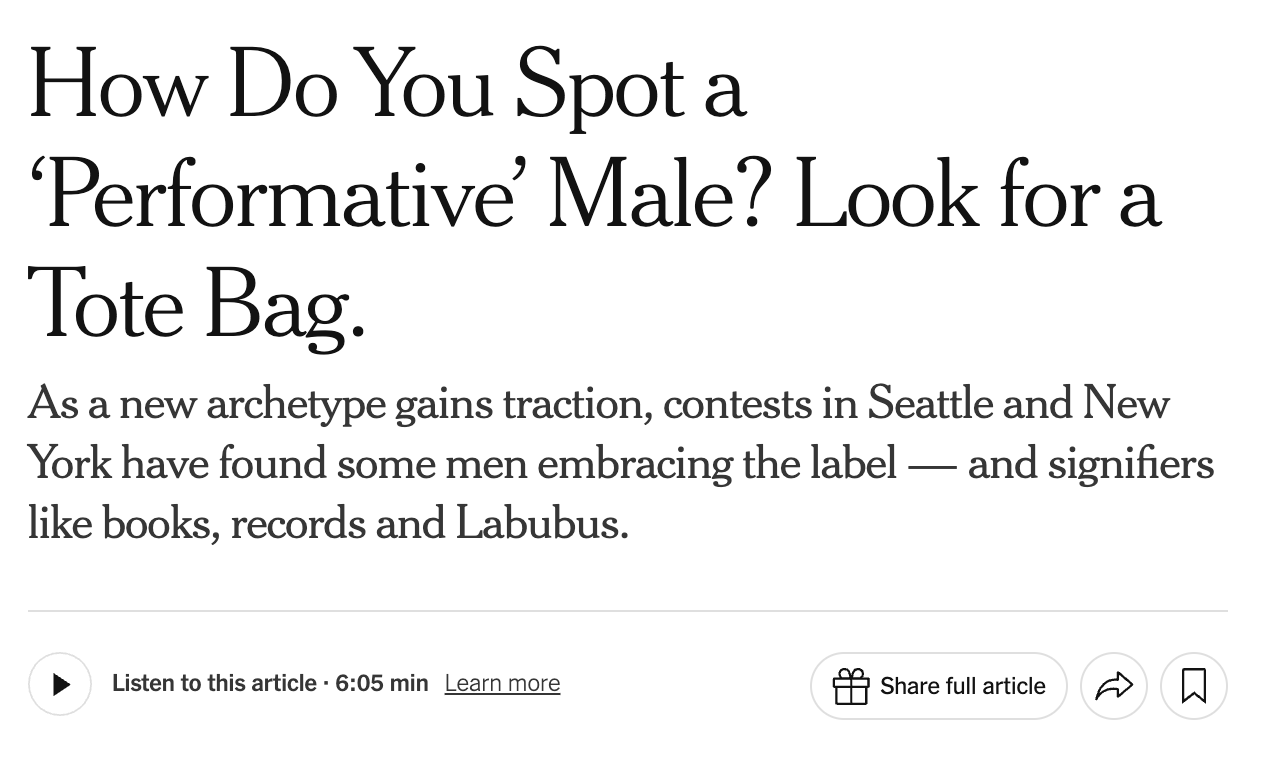
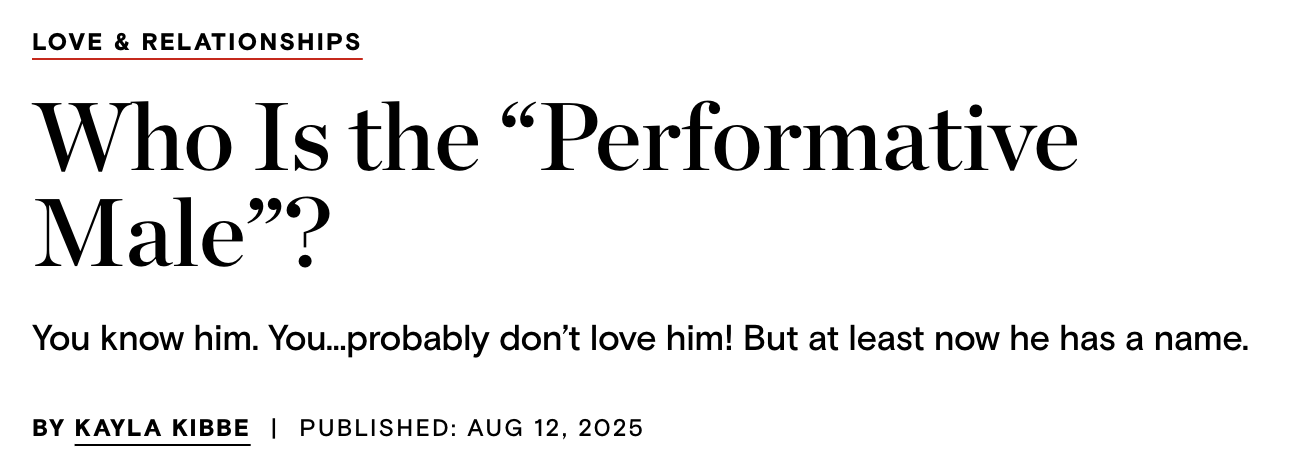
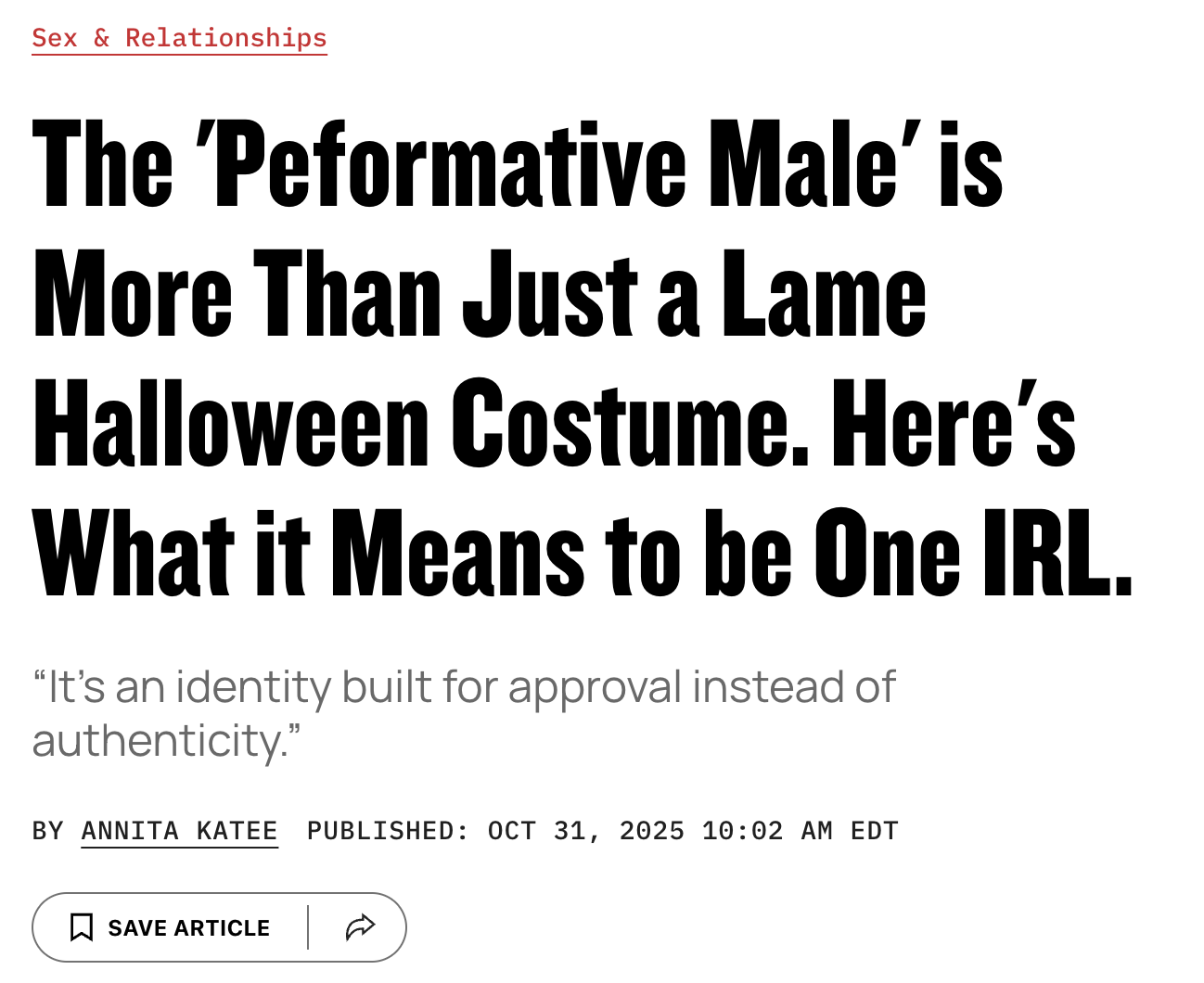
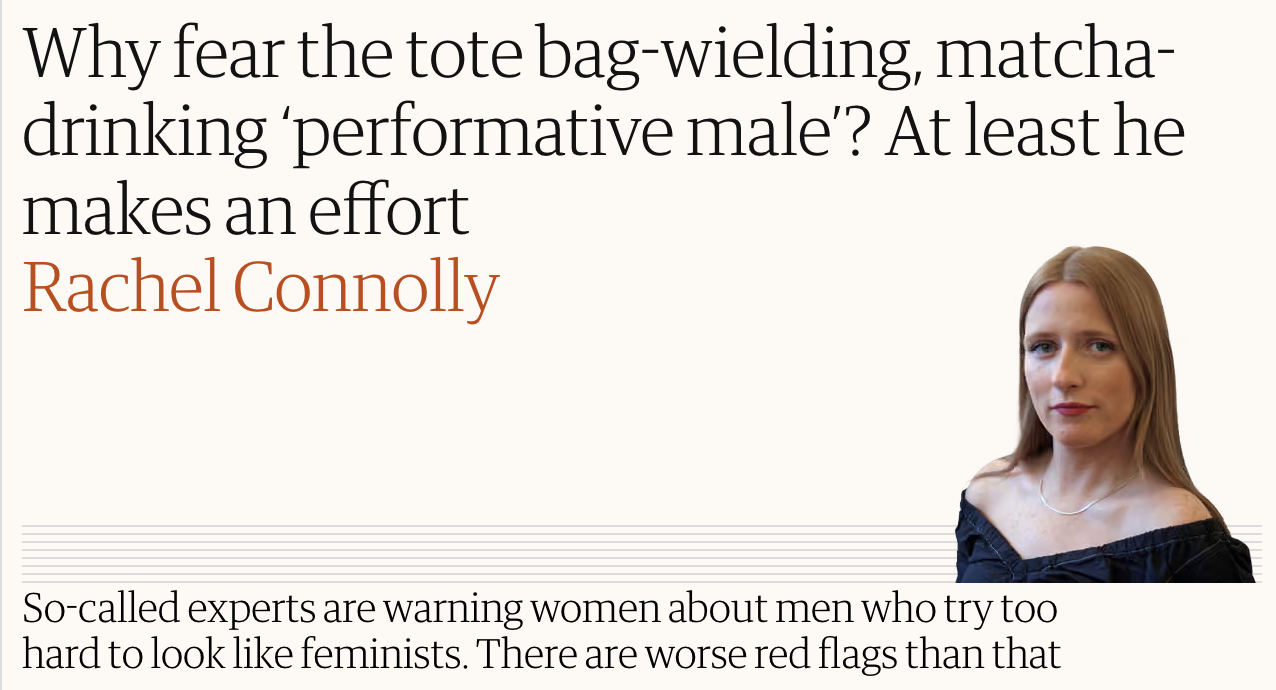
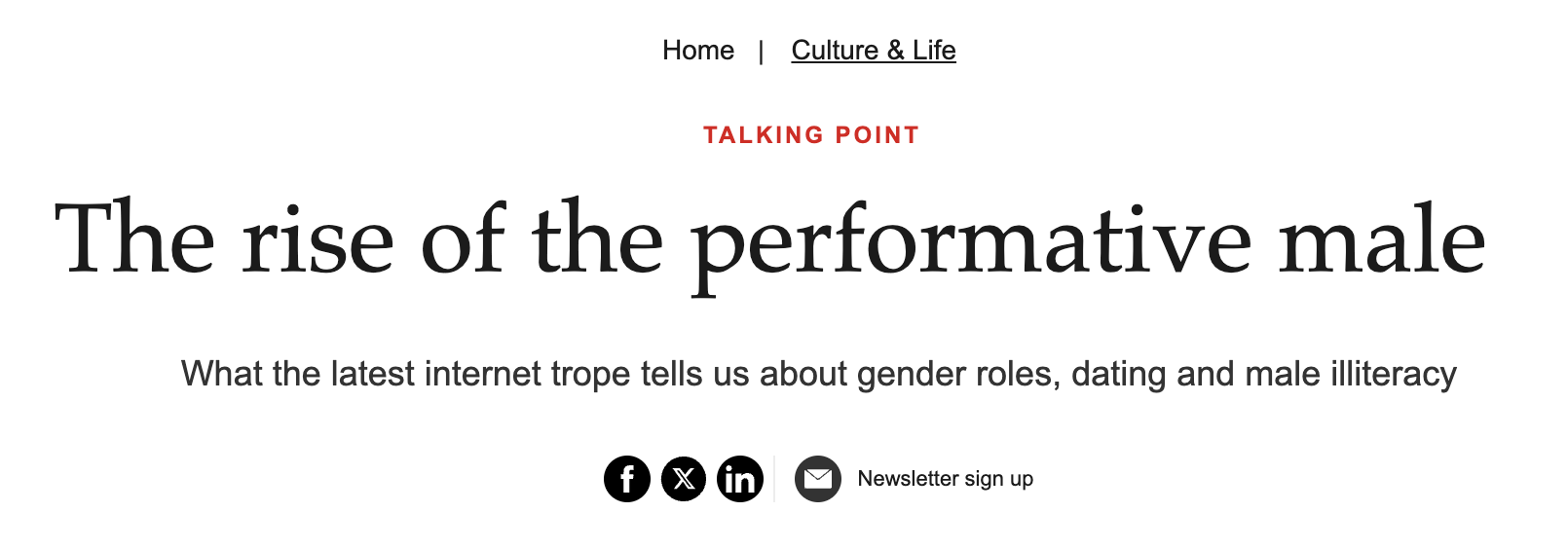
    You’ve seen and heard of the modern performative man: matcha, feminist literature, and tote bags. These curated traits are (supposedly) men’s signals to potential female love interests that they are respectful, progressive, and share similar hobbies.

    Let’s discuss what “performative” means and what this trend may reflect about broader society…or, maybe it’s just not that deep? Let me know.

    Performative, performative, performative

    We can interpret the word “performative” in several ways. First, as James Factora points out in their article for them, “performative” on the Internet usually means “virtue signaling.” It is considered performative, for example, to repost advocacy art on your Instagram story every time something horrific happens without taking meaningful action in real life. 

    The performative man also shares its name with Judith Butler’s concept of gender performativity from their 1990 book Gender Trouble. As Butler writes,

    “Gender is the repeated stylization of the body, a set of repeated acts within a highly rigid regulatory frame that congeal over time to produce the appearance of substance, of a natural sort of being” (Butler 45).

    Gender is not inherent, they argue, but emerges through repeated cultural performances of “man” and “woman.” 

    Beyond virtue signaling or gender performativity, the performative man is also the most literal version of a performance—it’s a show.

    Since the beginning of the trend, the matcha-drinking, Laufey-listening fashionista man existed more in online, hyperbolic and satirical skits than real life. Even when the trend moved offline, it was entertainment through “performative man contests” that required exaggeration and personality.

    I would argue that the performative man is a “show” and “virtue signaling,” but it is not an investigation into gender expression, even if it may offer a chance to play with it. However, this overlap of language has pushed many journalists and Internet users alike to grapple with Butler’s dense text and what it means to perform gender, and the performative man offers a clear example of what it looks like to intentionally and aesthetically present your gender. 

    Where did he come from?

    Amplifying historically desirable traits of masculinity in order to attract women isn’t new: what once may have been flashy wealth and brute strength is now feminist enlightenment and good style. So, what’s so enticing and troublesome for people about this particular iteration of a mating call?

    I first remember seeing videos of NYC men “reading” in public in 2024 – it was a video of a generic white man reading Emily Ratajkowski’s My Body in the West Village. Whether it began as a skit or someone had genuinely filmed a man reading in public, it doesn’t matter; the exaggerated and taunting videos started snowballing, all the way to the trend’s peak in 2025. Examples below:

    @betches

    there’s something very…attractive…about this // credit/permission: @finnharryy #boy #boys #hotboy #read #reader #bookish #bookworm

    ♬ original sound – Betches – Betches

    I’m more interested in why this trend became a thing, and why now. Why do men feel they must signal their politics to get a girl? Why do we immediately mock and parody that man and assume insincerity?

    I think the performative man trend represents a conflicted moment for masculinity, which is caught between a need to evolve and a society that scrutinizes every attempt to redefine it. It’s both a push-back against progressing gender norms and a way to experiment with them safely and at an ironic distance. 

    The push-back

    On the one hand, we can view the performative man as a reaction to fragmenting masculinities and diverging politics between genders. The performative man becomes a very tangible target for those worrying about the changing gender landscape. Men (and women!) can self-police masculinity under the guise of comedy, entertainment, and protecting women from harm and deception (similar to the rationale for keeping trans women out of the women’s bathroom). 

    There are way more men concerned about others altering their personal aesthetics to lure women with a curated facade of wokeness than there are men actually doing that, which demonstrates where society’s real fears lie. 

    Young women are becoming more liberal and young men are becoming more conservative. It makes sense that the trend involves a “fake” adoption of liberal aesthetics and values to attract women back. 

    We can also see the ideological split amongst men play out in the performative man. The red-pill, “man-o-sphere,” conservative men can suddenly no longer woo liberal women with traditional gender roles, so they discredit more progressive men as deceptive while affirming their own legitimacy. The trend targets inauthenticity (the Internet’s new favorite enemy) instead of queerness, and allows macho men to mock the less masculine without appearing overtly homophobic.

    The memeification of the performative man also helps to dismiss any man who has an actual interest in feminist literature or female singer-songwriters. By being so easily packaged in a “performative man starter pack,” this persona is revealed as easily replicable and therefore even more inauthentic if someone adopts it. Any man seeking to meet women at their level is now just a meme, reduced to a self-serving copycat. 

    While these macho men are not the ones necessarily participating in the TikTok trends and real-life competitions, dominant cultural trends often serve the interests of the patriarchy. Even if, on the surface level, we see a character that values feminism and respects women’s interests, the trend’s rhetoric is about making fun of him. 

    An ironic experimentation

    On the other hand, the performative man is a way for men to dip their toes into softer expressions while maintaining plausible deniability. As they redesign their personal aesthetics, they do so through an ironic and safe distance and never have to fully own the more feminine version of masculinity. It becomes an easily backtrackable “bit” in which they are just poking fun.

    Donning this “costume” may be liberating to men who wish to safely push the boundaries of male expression. It can also be comforting to have an easily identifiable aesthetic that fits within the social hierarchy, and perhaps it’s a baby step towards a more transgressive life.

    However, because it’s rooted in mockery and hyperbole, it does nothing to make the world more accepting of alternative masculinities.

    And it’s not just the people making fun of the performative man. It’s the performative men themselves, refusing to fully take on the risk of challenging traditional masculinity.

    In 2012, Christy Wampole published “How to Live Without Irony” in the New York Times to analyze the hipster who uses irony as a self-aware shield against criticism. “Irony,” she writes, “is the most self-defensive mode, as it allows a person to dodge responsibility for his or her choices, aesthetic and otherwise. To live ironically is to hide in public.” 

    She says that irony “signals a deep aversion to risk.” The performative man, I’d argue, avoids the risk of non-traditional masculinity, self improvement, and caring about relationships with women. 

    “If life has become merely a clutter of kitsch objects, an endless series of sarcastic jokes and pop references, a competition to see who can care the least (or, at minimum, a performance of such a competition), it seems we’ve made a collective misstep. Could this be the cause of our emptiness and existential malaise? Or a symptom?”

    With Labubus, Laufey, and a literal competition for who can be the most ironic, the performative man is an epitome of the ironic lifestyle that Wampole discusses. It’s both a competition of performance and a performance of competition. The in-person spectacle offers safety in numbers, and it’s a performance of a performance that even further distances the participants from the subject matter. 

    Instead of hyperbolizing and memeifying a man that challenges traditional masculinity, what if we explored what it would be like to embrace those traits without irony? And on the flip side, instead of signaling one’s values through style and music choices, what if we actually commit to the fundamental betterment of the self and community (i.e. actually read that feminist theory)?

    Wampole asks: “How would it feel to change yourself quietly offline, without public display, from within?” 

    The performative man trend allowed many young men to safely try on new aesthetics and masculinities. As it dies down and becomes oversaturated, I’m curious to see who continues to engage with it and how the trend reinvents itself. I hope that it has taken us one step closer to a mass realization of the mutability of gender, now that the words “performative” and “gender” have entered mainstream vocabularies together. 

    We don’t have to announce who we want to be…we can just be. In the age of AI art and entertainment that lacks human feeling, our vulnerability, desire, and sincerity are the most valuable things we have. 


    P.S. — Some related moments/ideas I’m thinking about:

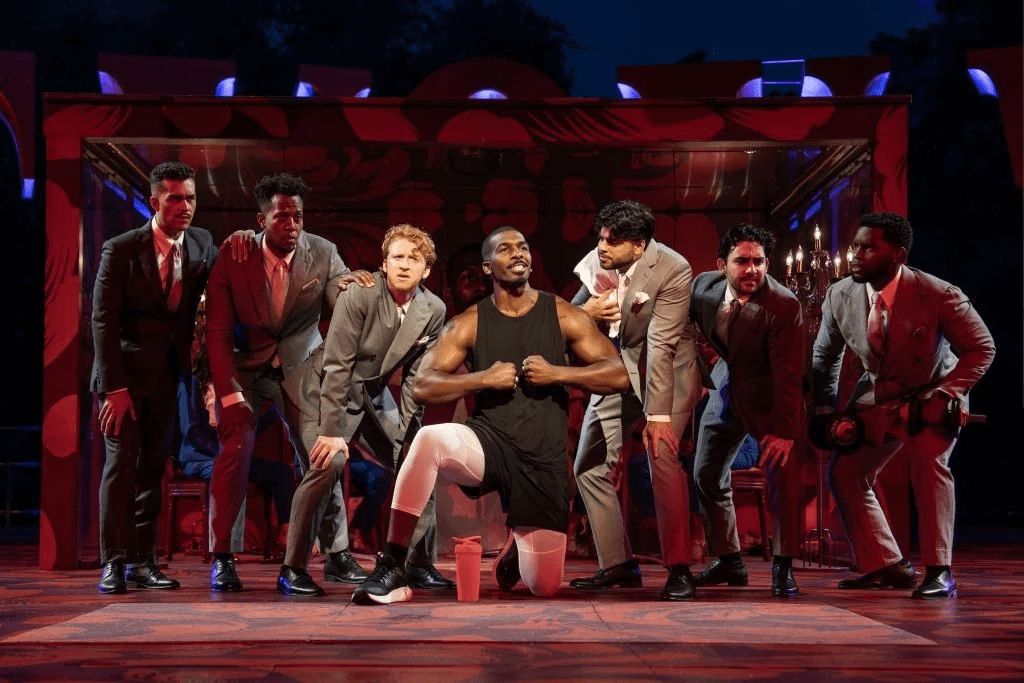
    The Public’s Shakespeare in the Park production of Twelfth Night that I saw this summer, with its gender-bending love triangle and gender performance. It represented Orsino as a stereotypical iron-pumping douchebag and began the performance with the Fool singing a line from As You Like It: “All the world’s a stage, and all the men and women merely players.”

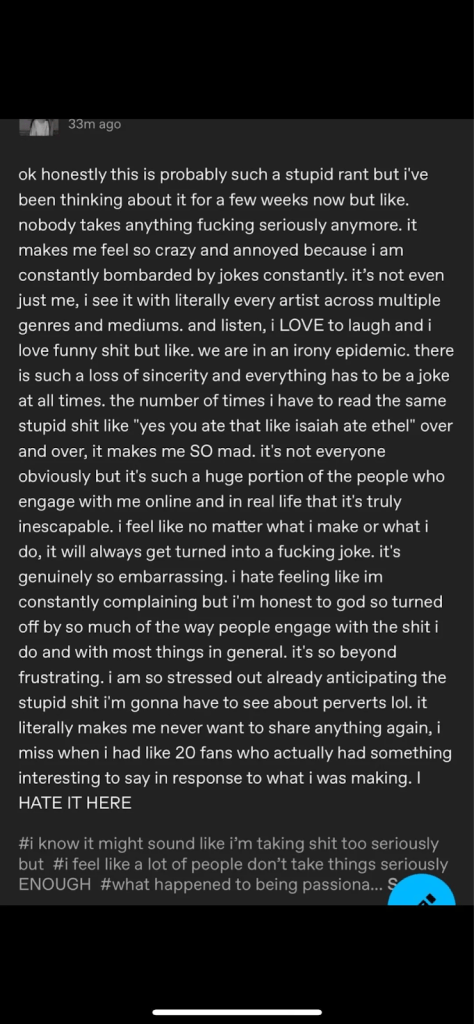
    A Tumblr post by singer Ethel Cain, where she writes that “we are in an irony epidemic.” Cain’s music deals with complicated and difficult themes like cannibalism and sexual violence, yet the Internet constantly turns them into a joke. Her art is art that affects, but fans deflect with humor, unable to internalize and be affected by raw, and often uncomfortable, emotion. She expresses her frustration in this now-deleted post.

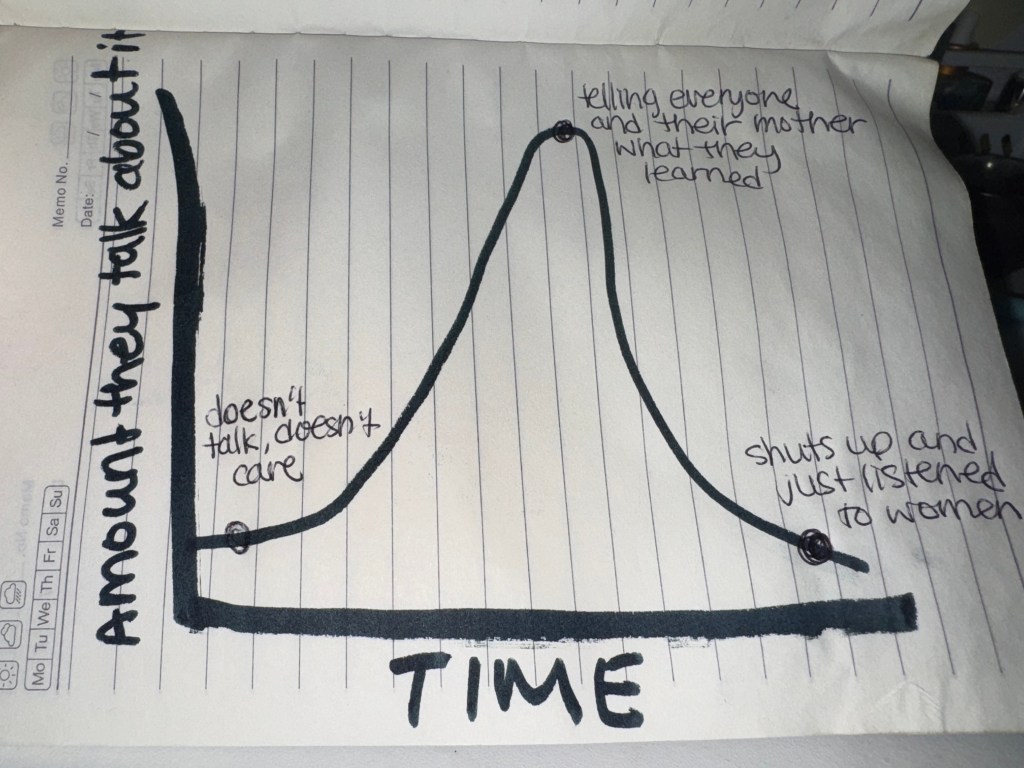
    This graph I made to depict men’s feminist journeys: Theoretically, a trend popularizing men reading feminist literature sounds great, but not when the point of the trend is literally to “fake” read it for a man’s own benefit… that’s not very feminist! It enforces a post-feminism culture and gives men no incentive to actually stride towards progress as they’d be equally as made fun of if they actually read the books!

    Below is how I envision a man’s journey with feminist theory in my mind. A man first discovers some aspect of feminism and wants to tell everyone what he’s learned. He may even broadcast the fact that he’s reading it to imply he’s “better” than other men.

    Then, the more he reads, he realizes the importance of learning quietly, applying what he can to his own life, and listening to women without drawing the attention back to himself.

    My graph: A man reading feminist theory’s journey:

    Thank you for reading!! xoxo

    Leave a comment

  • Hello Blog World!! <3

    My last class of my undergrad experience was an art history class taught in Spanish. My professor, who only spoke English when a student was utterly confused, paused at the end of his lecture. He looked up to the row of students tuned out on their laptops and said, “That’s it.”

    That’s it! My college experience was over. He turned on the lights, closed his computer, and we all walked out of the library basement classroom.

    I absolutely love school. I love the excitement on the first days of school. I love making class friends with the people who sit next to me. I love challenging myself. I love the schedule, the busy days, the people-watching in the library, being surrounded by people my own age.

    So, you can imagine my devastation when it dawned on me that everything I had ever known and loved was OVER! (Okay that’s dramatic but you get the point). 

    I just graduated from NYU Gallatin School of Individualized Study. I titled my concentration “The (De)Construction of Identity in Everyday Life and Popular Culture,” but don’t tell anyone because I’m planning on changing the title of it for every job interview. If someone cares enough to ask a follow-up question, I’ll usually start listing all the subjects I covered: gender studies, popular cultural studies, multi-media art, social impact, philosophy, phenomenology, perception, time, experience, truth. It keeps going. 

    Throughout my time at NYU, I would freak out about what I was going to do after college. What does one do with a gender studies major? Nothing!, according to the Internet. It turns out, there’s a lot of stuff you can do with it, which doesn’t help someone who chose a broad major where she didn’t have to commit to any one discipline, because she’s now faced with the same decision, only this time there’s a little more urgency!

    As graduation loomed, I became concerned with the fact that instead of learning tangible skills for a tangible job like many of my peers. I spent my time reading dense theory, learning new mediums of art, and writing essays on the cultural impact of celebrities. 

    Oh wait, I realized, those are all sort of useful skills! I was learning to see the world, to analyze the world, to understand my place in it. I learned to read and write and criticize and communicate, all great skills for literally any career! Even as I wrote out everything I learned from each of those disciplines for this blog post (not included but maybe I’ll share another time if anyone cares), I saw just how much I learned. Soft skills, curiosities, and questions that I now greatly value! 

    My dilemma still stands: what do I do with the rest of my life? 

    Long story short, I spoke with some grown ups and found myself starting in public relations, a nice interdisciplinary career where I still don’t have to commit to one area of interest. Since graduation, I’ve now been an intern at two different companies, working across consumer, healthcare, business, and tech accounts and learning lots. I’ve gotten a taste of creative strategy and analytics as well as more traditional PR. 

    I should probably save my observations about corporate life when I’ve been in it a little longer. My first impressions are, though, that it’s both not what I expected and everything that I expected. It’s definitely different from school. There are even tighter deadlines, less room to mull things over and sit with ideas. Less room for play, even though the tasks themselves can be playful and creative. 

    As I’m digesting all this new information and figuring out where I fit into the corporate world, I’m trying to figure out a way to incorporate all that I’ve learned in school. At Gallatin, I got to study exactly what I wanted, and skip the subjects I didn’t. Not to toot my own horn, but I probably skipped class less than 10 times all of college, and if I didn’t have time to complete a reading, I would go back after class and read it because I was so interested in it. 

    Work is different though. While my attendance record proves helpful for a 9-5 job, I cannot just avoid the things I don’t want to do! Instead, I’m forcing myself to use maybe the most valuable skill I learned in my interdisciplinary program: how to make even the most seemingly irrelevant stuff somehow useful and interesting to me. If anyone has any tips on how to make AI and tech innovation related to my interests, please let me know! 

    Sitting at a desk all day (or my bed, working from home) is an adjustment. So is having less time to see my friends, and endless screentime, and morning commutes with all the suits on the train. There’s also things to like though, or at least attempt to glamorize: a new work-appropriate wardrobe with endless supplies of ballet flats, new work friends, picking out my emojis on Teams, and laughing at corporate lingo. Nothing is forever!

    I’m trying to cut myself some slack for this massive life change where suddenly my entire purpose has changed, but I’m also using this discomfort as a sign to pursue what I do like and integrate what I know feels good into the next steps of my career and life (grad school here I come?!?!)

    Because, that’s not IT! What I loved about life on May 15th (graduation) can still be the same stuff as May 16th, and every day after that. It just takes a little bit more work, and I am excited for the challenges of the new scary big world.


    Welcome to my blog! I have several half written blog posts but I had to rip the bandaid off and post something. So here you go, and talk to you soon! ❤

    One response to “Hello Blog World!! <3”

    1. Charles Fitzgerald Avatar

      Welcome to the blogosphere!!!

      Words, memes, reflection – looking forward to more!

      The “several half written posts” thing may be genetic 😉

      Like

    Leave a comment